30 March 2017
A person’s ability to paint their face can be a great benefit, especially if they are someone who is interested in creating their own brand. This skill will make it easier for them to create a unique image for themselves, without having to rely on the expertise of a professional. To draw a self-portrait, there are important technical skills that one must keep in mind.
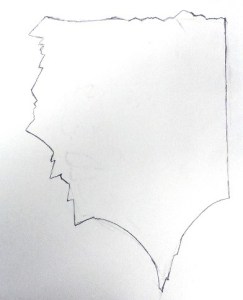
Conceptualize: Imagine you are the artist. It is first important for you to have an idea of what you are trying to portray with your portrait. You should have a theme. The concept of your portrait will ultimately determine the way it turns out.
Annalee Elmore, 21, a professional studies major with a concertation in art and psychology at the University of Memphis, emphasizes the importance of this. “So, really asking yourself what your purpose is,” Elmore said, “and making decisions off of that purpose. What’s going to get that idea, or thought or emotion across better.”
For example, if you are trying to convey a certain emotion that captures a personal event that has happened in your life, perhaps one of sadness, then you’ll most likely think to use dark colors and a composition that conveys that emotion. Otherwise, if you just simply want to create a picture of yourself, then you would be less selective about color. It really depends on what you want to do, but always remember, a concept will bring about your piece together nicely.
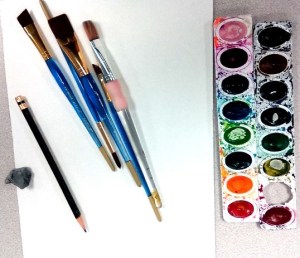 Choose the right mediums: After you decide what theme you want to have for your portrait, you must choose the right material, or medium. Watercolor paint on watercolor paper is good for a beginner because it provides more flexibility. If you make a mistake, you will have a better chance of fixing your mistake using watercolor as supposed to using acrylic or oil paint, which are harder to manipulate.
Create a rough sketch: After you’ve gathered your painting materials, it is time to rough sketch your idea on a separate sheet of paper. Your sketch can be as vague or as elaborate as you like, but it is important that you have at least one. This will make it easier to draw your desired composition.
Alexandra Johnson, 23, a graphic design major at the University of Memphis, agrees. “It’s important to outline and rough sketch before you start,” she said. “It’s also good to jot down ideas.”
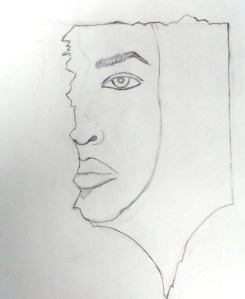 Start your outline drawing: This is where the fun begins. You’ve created an idea and have made a sketch of it. Now, it’s time to start sketching your idea onto your watercolor paper. Before you start, keep Elmore’s advice in mind.
“I would say that there are a lot of guidelines when it comes to proportions, but that depends on if that’s what they’re into,” she said. “Do they want their portrait to be more realistic looking? And if so, they should pay more attention to how some things measure up against others,” she said.
Furthermore, think about the dimensions of the paper you are using, and make sure they match up with the dimensions from your rough sketch.
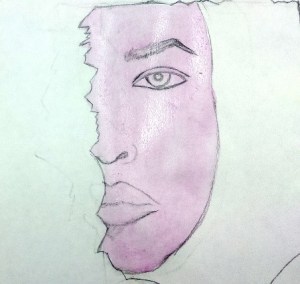 Begin painting…in layers: After you are finished with adding enough detail to your outline, begin adding base color to your portrait. This includes deciding what undertones you want to be seen in your portrait. If you want to portray your natural complexion, then look closely at yourself in the mirror and then decide whether you notice a white, red, or yellow undertone in your completion. Whichever one you see the most, use a light shade of this color to cover the whole area of your portrait that shows skin tone. If you are using an unnatural color for you portrait, like blue, then begin by painting a light shade over the area of your complexion. As each layer dries, add a slightly darker shade over the previous layer, and continue doing this until your complexion is the desired shade. It is important to use this technique so you end up with a more even skin tone. Regardless of how you want your complexion to look, keep in mind other factors, like your facial expression. Jed Jackson, a professor of painting at the University of Memphis, emphasizes this.
“Study facial expression and facial anatomy,” Jackson said. “Know how the muscles work and how very tiny changes in drawing can create mood.”
Continue the layer technique and bring out your facial features with more depth by adding darker shades. To do this, look at yourself under some type of light, then study the shadows and dimensions that are created under this light source. Whatever you see, do your best to emulate it.
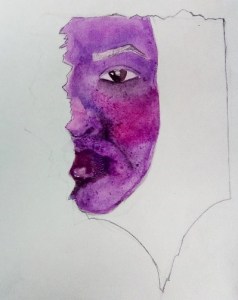 Take a break: After you are done with a substantial amount of your portrait, step away from it for a little while and let it dry. Remove from your mind the details you have added into it, and just focus on something different. This technique is helpful so when you come back to your work, you’ll be better able to see what details need to be added.
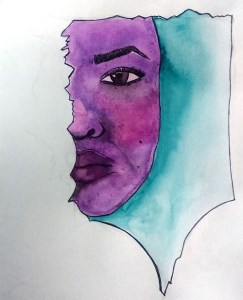
Finish: During this step, you are basically trying to put all the pieces of your portrait together. At this point, you will most likely be able to see all the details that are still missing, and have the opportunity to go back and add these details to create character.
“Sensing character and feeling and somehow indicating that with line, shape and color-it is all rather mysterious actually,” Jackson said. “This is where the talent of the artist is most noticeable and necessary.”
The rewarding feeling of finishing a work of art is only something that can be felt by those who have done it before. At this point, hopefully, you’ll experience it for yourself.
“I enjoy the process of developing a painting idea from the void, from nothing, into a plan and then executing the plan. I simply enjoy building a painting one step at a time,” – Jed Jackson
 loischarm.com